
Meta Ads vs. SEO: Where Should You Actually Spend Your Budget First?
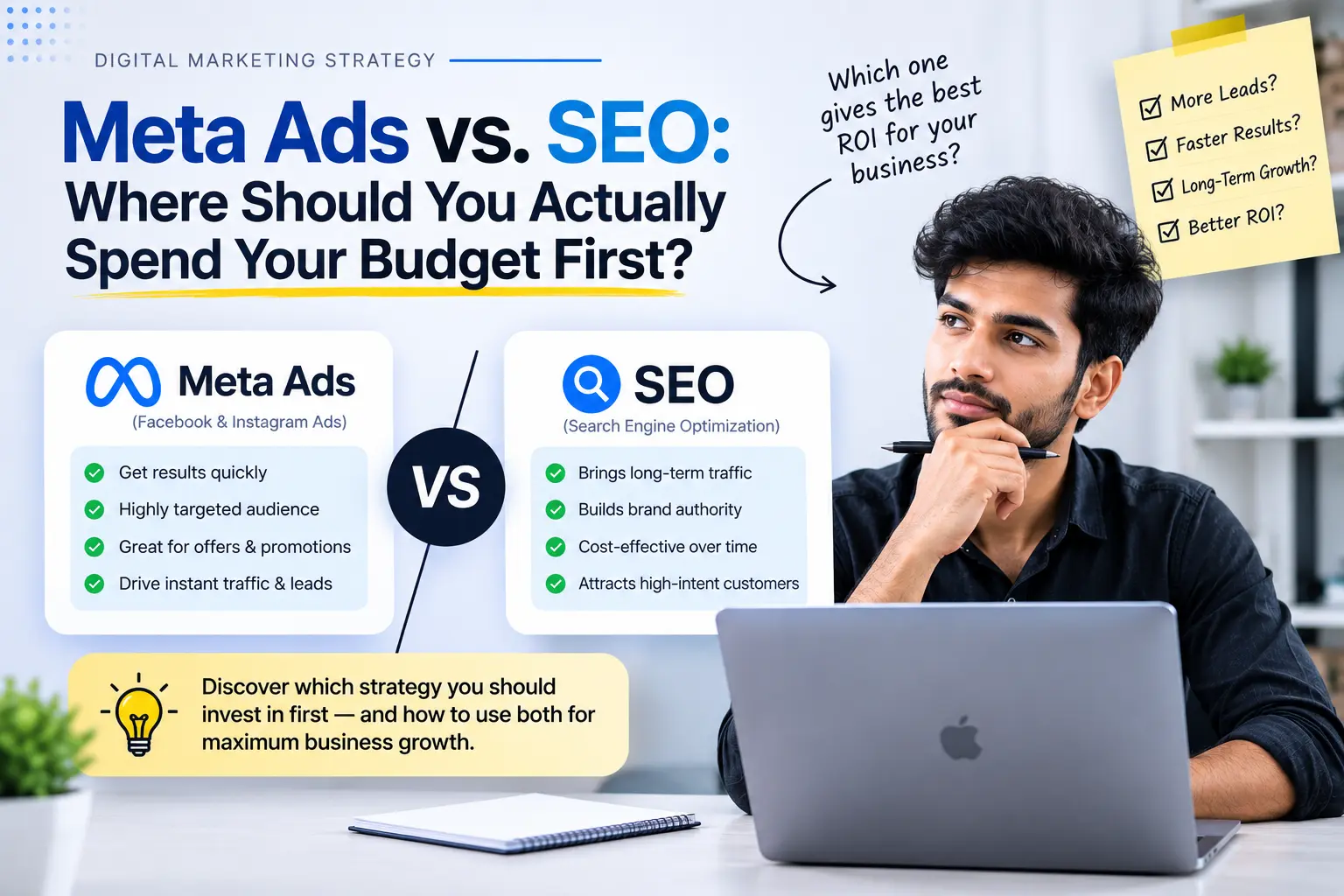
If you’re running a business online, one question comes up again and again: Meta Ads vs SEO — which one should you invest in first?
You may be thinking about running Instagram and Facebook ads to get customers quickly. At the same time, you may have heard that SEO can bring consistent visitors from Google without paying for every click.
Both strategies can work. But they work in very different ways.
Meta Ads can help you reach a targeted audience quickly, while SEO focuses on building your visibility in organic search results over time. The right choice depends on your business goals, budget, competition, and how quickly you need results.
In this guide, we’ll compare Meta Ads vs SEO, explain their advantages and disadvantages, and show you how to decide which strategy makes sense for your business.
Meta Ads vs SEO: What Is the Difference?
The simplest difference is this:
Meta Ads are paid advertising, while SEO is organic search optimization.
Meta Ads allow businesses to promote products, services, offers, and content across platforms such as Facebook and Instagram. You can create campaigns based on factors such as location, audience characteristics, interests, and campaign objectives.
SEO, or Search Engine Optimization, is the process of improving your website and content so that search engines can better understand it and users can discover it through relevant searches.
For example, imagine you own a digital marketing agency in Malappuram.
Someone searching Google for:
“digital marketing strategist in Malappuram”
already has a specific need.
If your website appears in relevant organic results, that person can discover your business without you paying for every visit.
With Meta Ads, you could instead create an advertisement and target people in Malappuram who may be interested in your services.
Both approaches can generate customers, but the customer journey is different.
-
Think of Meta Ads like turning on a tap.
You create a campaign, select your audience, set a budget, create your advertisement, and launch it. Your campaign can then begin reaching people who match your targeting and campaign settings.
Why Meta Ads Can Be Effective
1. Fast visibility
One of the biggest advantages of Meta advertising is speed. Instead of waiting for a new website page to gain organic visibility, you can launch a campaign and start reaching your selected audience.
2. Audience targeting
Meta advertising provides a range of targeting and campaign options. This can be particularly useful when you know who your ideal customer is.
3. Useful for promotions
If you have a limited-time offer, product launch, event, seasonal promotion, or special service package, paid social advertising can help you get the message in front of potential customers quickly.
4. Easy to test different creatives
You can test different images, videos, headlines, offers, and audiences to discover which combinations produce better results.
The biggest challenge is ongoing cost.
When your campaign is active, you’re paying for advertising. When you stop investing, the paid traffic from that campaign generally stops as well.
That makes Meta Ads useful for immediate campaigns, but businesses should avoid becoming completely dependent on paid traffic.
How SEO Works
-
SEO is more like building an asset.
Instead of paying for each advertising campaign, you improve your website, create useful content, target relevant search queries, improve technical elements, and build a website that provides a good experience for visitors.
Google explains that SEO helps search engines understand your content and helps users discover your pages through search.
Why SEO Can Be Powerful
1. Long-term visibility
A well-optimized page can continue attracting organic visitors after it has been published.
That doesn’t mean SEO is completely free or that rankings are permanent. Search results change, competitors publish new content, and websites need ongoing optimization.
But unlike a paid campaign, a useful organic page can continue working for your business after publication.
2. Search intent
SEO can reach people at the moment they are actively searching for something.
For example:
- best digital marketer in Malappuram
- SEO expert in Malappuram
- digital marketing services near me
- Meta Ads agency in Kerala
These searches can indicate that someone is looking for information, a service, or a solution.
3. Builds authority
Consistently publishing helpful content can help establish your website as a useful resource in your industry.
4. Supports local businesses
Local SEO can be especially valuable for businesses that serve a specific city, district, or region.
A business targeting customers in Malappuram, Calicut, Palakkad, or Ernakulam can create location-focused pages and content that match relevant local search intent.
The Disadvantage of SEO
SEO requires patience.
There is no guaranteed timeline for reaching a particular position in Google. Some changes can be reflected relatively quickly, while others can take weeks or months to show meaningful impact. Google recommends monitoring results and assessing changes over time rather than expecting instant results.
Meta Ads vs SEO: Key Differences
| Factor | Meta Ads | SEO |
|---|---|---|
| Traffic type | Paid | Organic |
| Speed | Fast | Gradual |
| Initial investment | Advertising budget | Content and optimization |
| Long-term value | Campaign dependent | Can build lasting visibility |
| Audience targeting | Highly flexible | Based heavily on search intent |
| Best for | Quick campaigns | Sustainable visibility |
| Results | Can begin quickly | Usually takes time |
| Content requirement | Ad creatives | Website content |
| Ideal for | Offers, launches, leads | Search traffic, authority, long-term growth |
The comparison shows why there isn’t one universal winner.
The better strategy depends on what your business needs right now.
Meta Ads vs SEO: Which Is Better for Small Businesses?
For many small businesses, the answer isn’t simply Meta Ads vs SEO.
It’s about using each strategy at the right stage.
If your business needs leads immediately, Meta Ads may make sense because you can start a campaign without waiting for organic rankings to develop.
If you’re building a business for the long term, SEO can help you create an organic search presence that continues working beyond individual campaigns.
For example, a new restaurant could use Meta Ads to promote an opening-week offer while simultaneously creating and optimizing its website for relevant local searches.
A service business could use paid campaigns to generate initial enquiries while building SEO content around the questions and services its customers search for.
When Should You Choose Meta Ads?
Meta Ads may be the better starting point if:
- You need leads quickly
- You are launching a new product
- You have a limited-time offer
- You want to test a new service
- You have strong visual content
- You know your target audience
- You have a dedicated advertising budget
For example, if you’re launching a new fitness program and want enquiries this month, waiting for organic rankings may not be the fastest route.
A well-planned Meta campaign could help you test the offer and collect initial leads.
When Should You Choose SEO?
SEO may be the better investment if:
- You want long-term organic traffic
- Your customers regularly search Google
- You want to reduce dependence on paid traffic
- You’re building a strong brand presence
- You have useful expertise to share
- Your business depends on local searches
- You want your website to become a long-term marketing asset
Google recommends creating useful, unique, well-organized content rather than focusing on tricks designed only for search engines.
That means successful SEO should start with the user.
Can You Use Meta Ads and SEO Together?
Yes — and for many businesses, this is the smartest approach.
Instead of thinking of Meta Ads and SEO as competitors, think of them as two parts of the same digital marketing strategy.
You can use Meta Ads to generate immediate visibility while SEO works in the background.
For example:
Month 1–3
Use Meta Ads to generate traffic, leads, enquiries, or sales.
At the same time:
- Optimize your website
- Publish helpful blog content
- Improve service pages
- Target relevant keywords
- Strengthen internal linking
- Improve local SEO
- Monitor Google Search Console
Month 4 onwards
As your organic visibility improves, you can evaluate which channels generate the best results and adjust your advertising budget accordingly.
This creates a more balanced marketing system.
Meta Ads vs SEO: Which Gives Better ROI?
There is no universal answer.
Your return on investment depends on factors such as:
- Your industry
- Competition
- Customer lifetime value
- Advertising costs
- Website conversion rate
- SEO competition
- Content quality
- Search demand
- Offer quality
- Sales process
For Meta Ads, you can closely monitor campaign metrics and adjust your budget and targeting.
For SEO, you need to look at organic impressions, clicks, rankings, conversions, leads, and revenue over a longer period.
The important question isn’t simply:
“Which is cheaper?”
A better question is:
“Which channel brings qualified customers at a sustainable cost for my business?”
A Practical Strategy for Local Businesses
If you’re a local business owner, I recommend thinking about your marketing in three stages.
Stage 1: Generate Immediate Attention
Use Meta Ads when you have an offer or service that needs immediate visibility.
Create a clear advertisement and send people to a focused landing page, enquiry form, phone number, or WhatsApp conversation.
Stage 2: Build Organic Visibility
At the same time, invest in SEO.
Create useful pages around the services and questions your customers search for.
For example:
- Digital marketing services in Malappuram
- SEO services in Malappuram
- Meta Ads services in Malappuram
- Digital marketing strategist in Malappuram
Stage 3: Measure and Improve
Don’t judge your marketing only by impressions or clicks.
Track:
- Website visitors
- Leads
- Calls
- WhatsApp enquiries
- Conversion rate
- Cost per lead
- Organic traffic
- Search impressions
- Search clicks
- Revenue
Google Search Console can help website owners understand how their pages perform in Google Search.
Some businesses invest everything in advertising and completely ignore SEO.
Others spend months on SEO without having any short-term lead-generation system.
A balanced strategy can reduce this risk.
Sending paid traffic to a poor website
Getting visitors is only half the job.
If your website is slow, confusing, difficult to navigate, or lacks a clear call to action, paid traffic can become expensive without producing enough enquiries.
Expecting instant SEO results
SEO isn’t a button you press.
Your website may need technical improvements, better content, stronger internal linking, and consistent optimization.
Focusing only on keyword density
Don’t write an article simply to repeat a keyword.
Google explicitly warns against keyword stuffing.
Use your primary keyword naturally and cover the topic comprehensively.
Meta Ads vs SEO: The Best Choice for Your Business
So, Meta Ads vs SEO — which one should you choose?
If you need quick visibility, leads, or sales, Meta Ads can be a strong option.
If you want long-term organic visibility, search traffic, and a stronger website presence, SEO deserves serious attention.
But you don’t necessarily have to choose only one.
For many businesses, the strongest strategy is:
Meta Ads for immediate results + SEO for long-term growth.
Paid advertising can help bring customers today while SEO builds an organic foundation for tomorrow.
Your marketing budget should therefore be based on your goals, customer journey, competition, and expected return — not simply on which channel is currently popular.
Frequently Asked Questions About Meta Ads vs SEO Is SEO better than Meta Ads?
Not necessarily. SEO and Meta Ads solve different marketing problems. SEO focuses on organic search visibility, while Meta Ads focuses on paid audience reach. The better option depends on your business goals.
Are Meta Ads good for small businesses?
Yes. Meta Ads can be useful for small businesses when the audience, offer, creative, landing page, and budget are properly planned.
How long does SEO take to work?
There is no guaranteed timeframe. Some SEO changes can show effects within weeks, while meaningful growth may take months. Google recommends allowing time to evaluate changes and continuing to improve the site.
Can I run Meta Ads while doing SEO?
Yes. In fact, combining paid advertising with SEO can provide both short-term traffic and long-term organic growth.
Which is cheaper, Meta Ads or SEO?
Neither is automatically cheaper. Meta Ads require advertising spend, while SEO requires investment in content, technical optimization, strategy, and ongoing work.
Should a new website focus on SEO or Meta Ads first?
If immediate leads are important, Meta Ads can help generate initial traffic while SEO is being developed. If immediate results aren’t essential, you can prioritize building your organic search foundation.
Final Verdict: Meta Ads vs SEO
The real question isn’t Meta Ads vs SEO.
The better question is:
“What does my business need right now, and what will help it grow sustainably?”
Use Meta Ads when speed matters.
Use SEO when long-term visibility matters.
And when your budget and resources allow it, combine both.
A strong digital marketing strategy doesn’t depend on one channel. It creates multiple ways for potential customers to discover your business, trust your brand, and eventually become customers.
If you’re unsure where to start, analyze your current website, competitors, target audience, budget, and business goals before deciding where to invest.
Need help choosing between Meta Ads and SEO?
Connect with me through my website and let’s create a digital marketing strategy based on your business goals.
THANK YOU
For Your visit